Friday, December 21, 2012
The world did not end today.
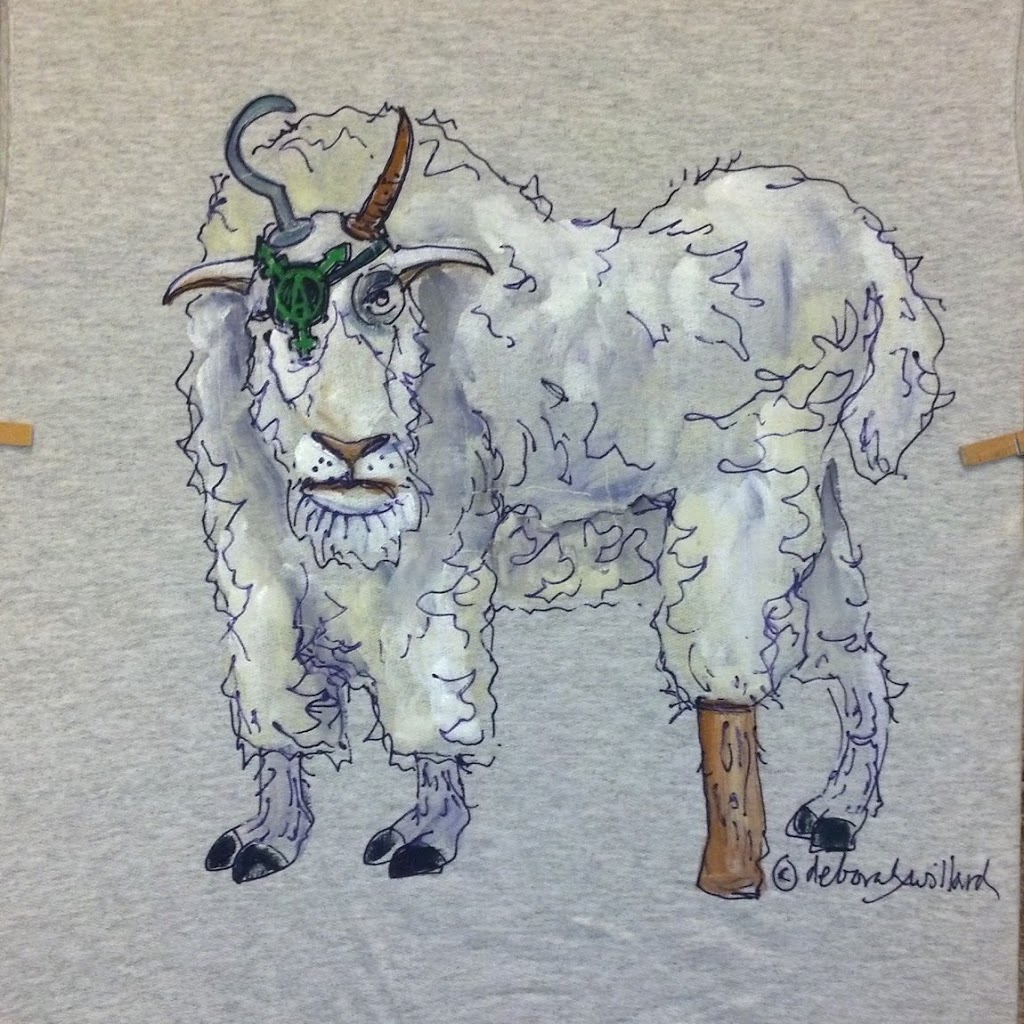
I get to keep painting stuff like Pirate Crab. Painted him twice and sold the one off the wall in the past 10 days or so. And this past weekend, I even painted Pirate Mountain Goat. Definitely a first.
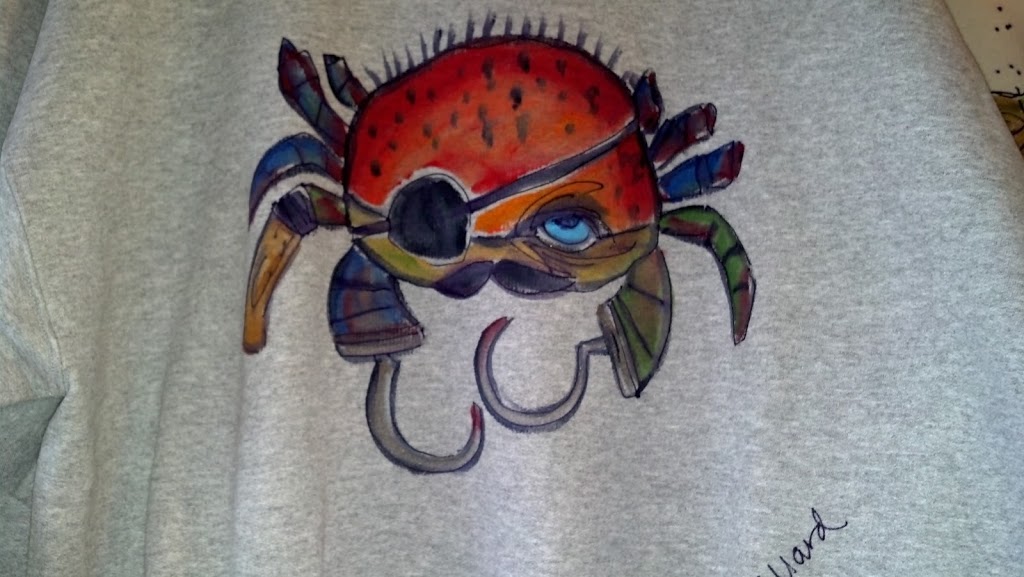
Pirate Crab owes his life to a happy accident. I recall a Saturday evening in myshop in St.John, ca. 2003 or 2004, when I locked the door at 9pm, turned music up a little, and started painting a shirt for myself to wear. I was playing around with some new fish faces and shapes, turning the iconic St.John Petroglyph shape into a jellyfish. I was also trying a new face on the orange crab near the bottom of the shirt. I messed up the eye, however, and the only solution was to give him an eye patch. Ta-DAAAAAAAAAA! Pirate Crab was born.
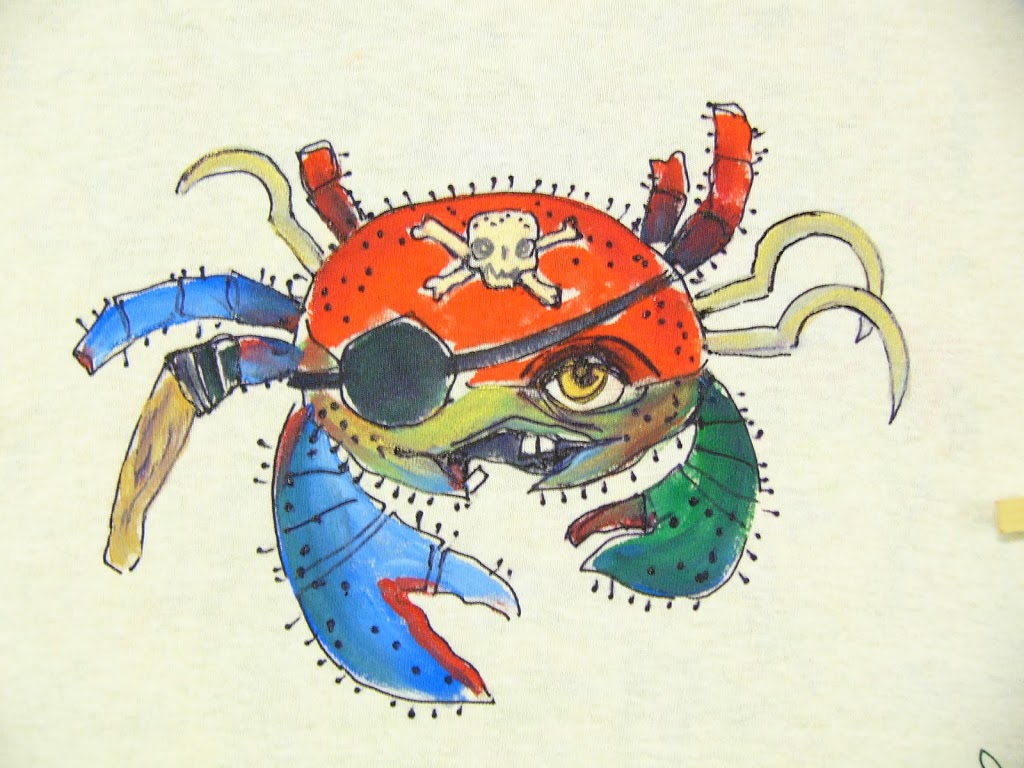

He has evolved over the years, first acquiring a pegleg, then a hook instead of a claw, sometimes 3 hooks, sometimes holding a jolly roger, breaking the pole that the raggedy flag is attached to. A few times he’s gotten a really gnarly look, but he gets too scary-looking for young kids, so I reserve the meanest-looking crabs for guys.
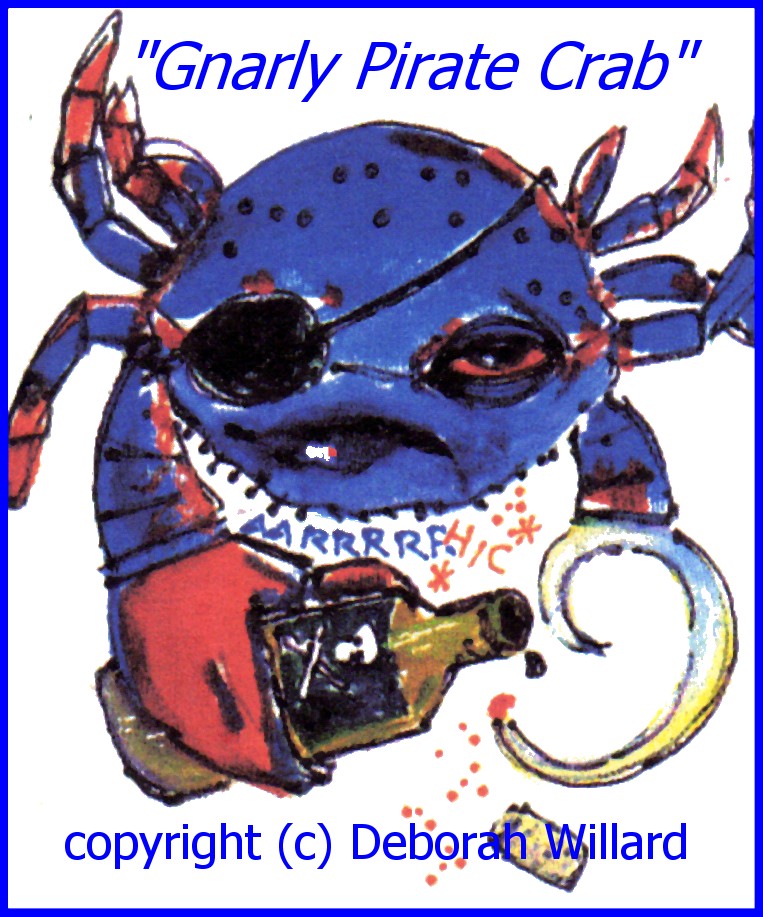
Once I painted him crushing a Nemo-Fish between his big, mean front claws. That one didn’t play well with the Disney set one bit. Or even mean, macho 12-year-old boys.
My favorite variation involves some “word play.” Literally. I paint the word “AAARRRRGGGHH” in bold capital letters in an uneven line beneath the crab, with his big front claws holding a couple of the letters tightly so as to distort them. Every now and then I have to let my calligraphic roots show.
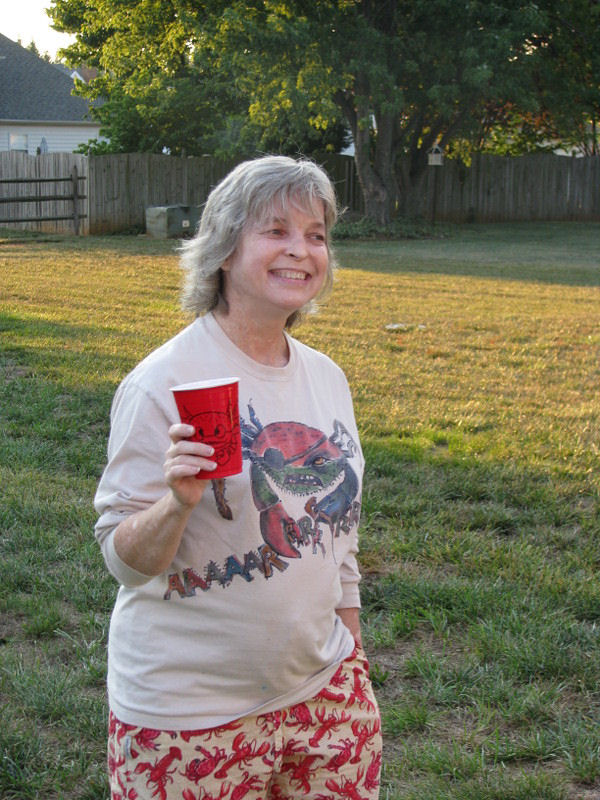
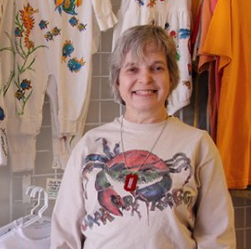
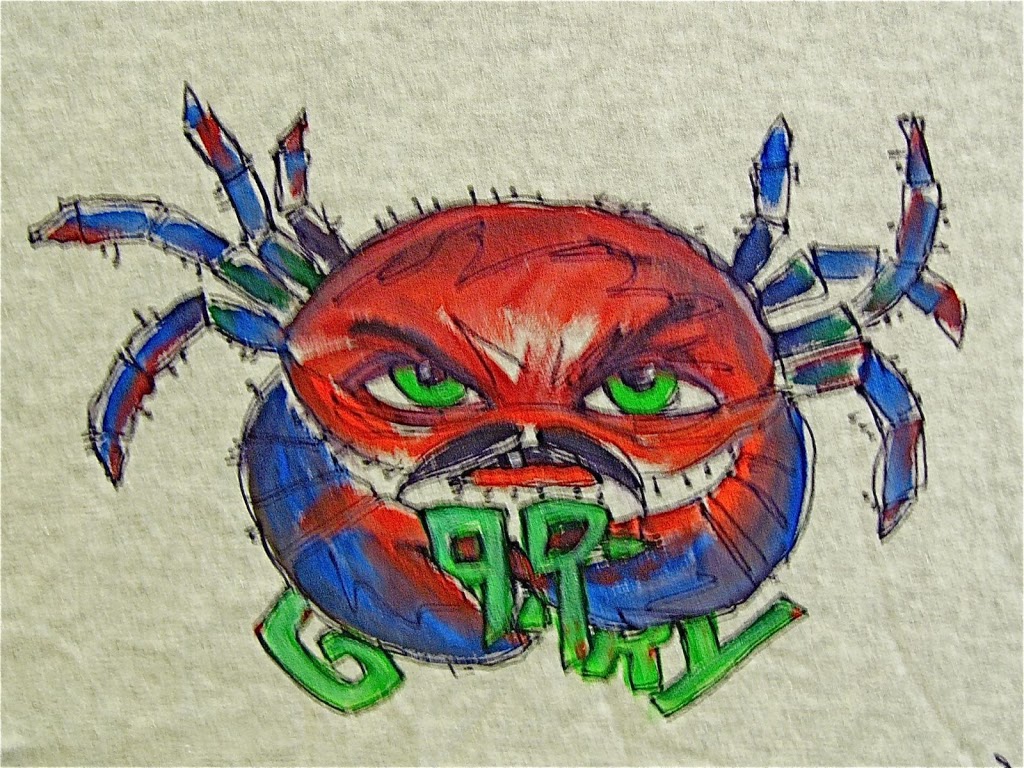
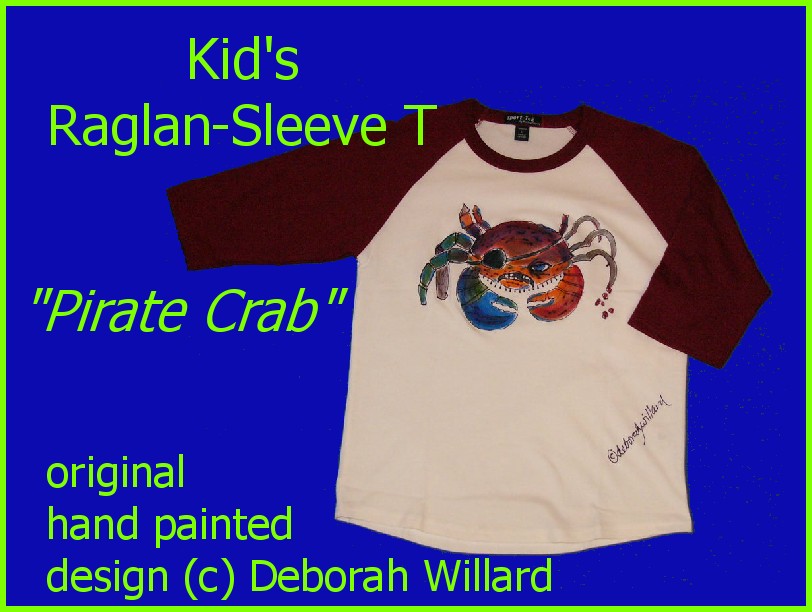
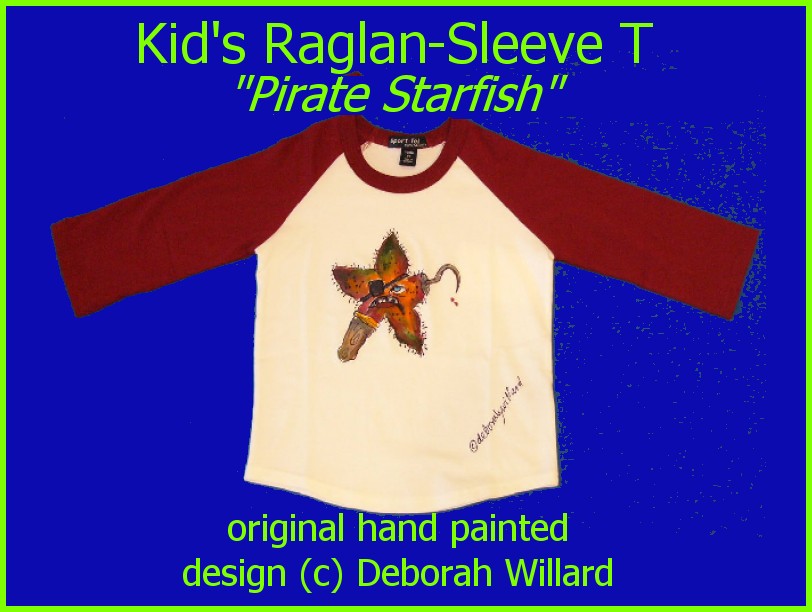
Pirate Crab has a companion, Pirate Starfish, which I sometimes paint on the back of a Pirate Crab shirt.
And once in a while, Pirate Starfish
gets to hold center stage on the
front of the shirt.
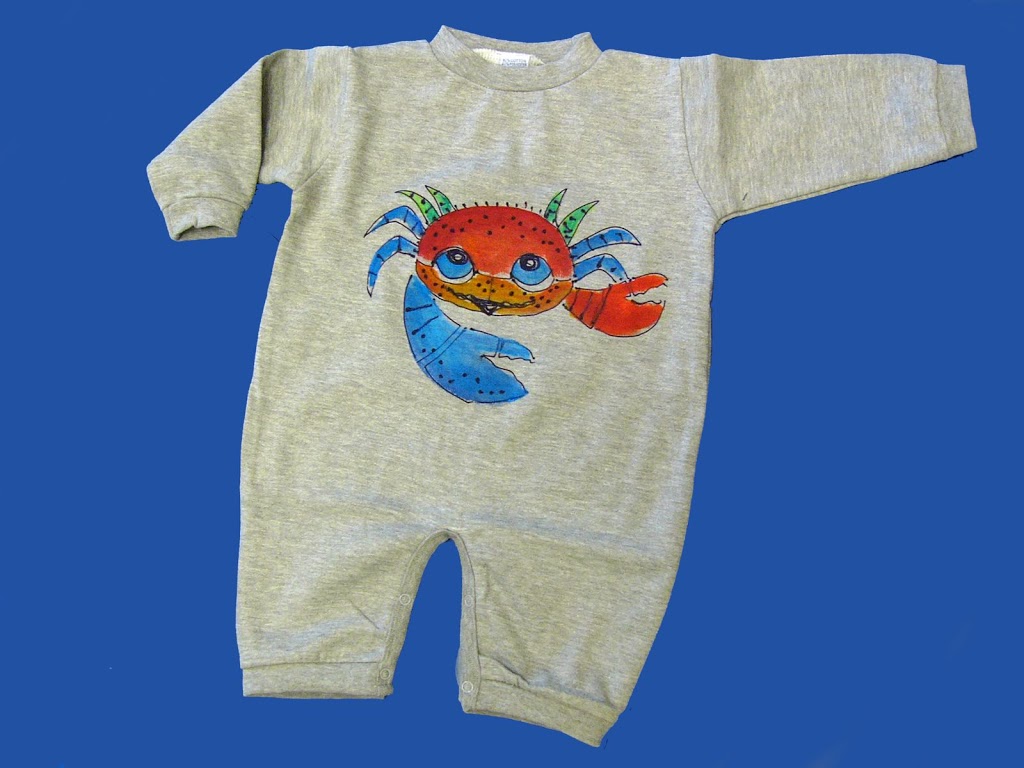
Don’t know why I like to paint crabs. Besides Pirate Crab, I paint Happy Crab and Crabby Crab.
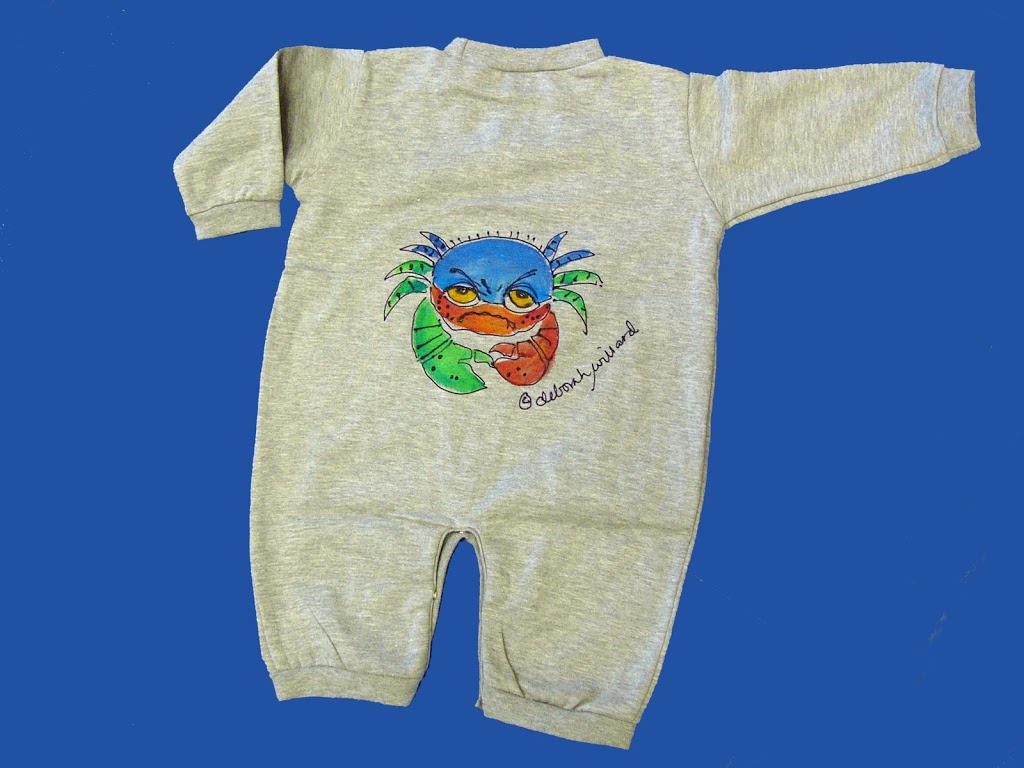
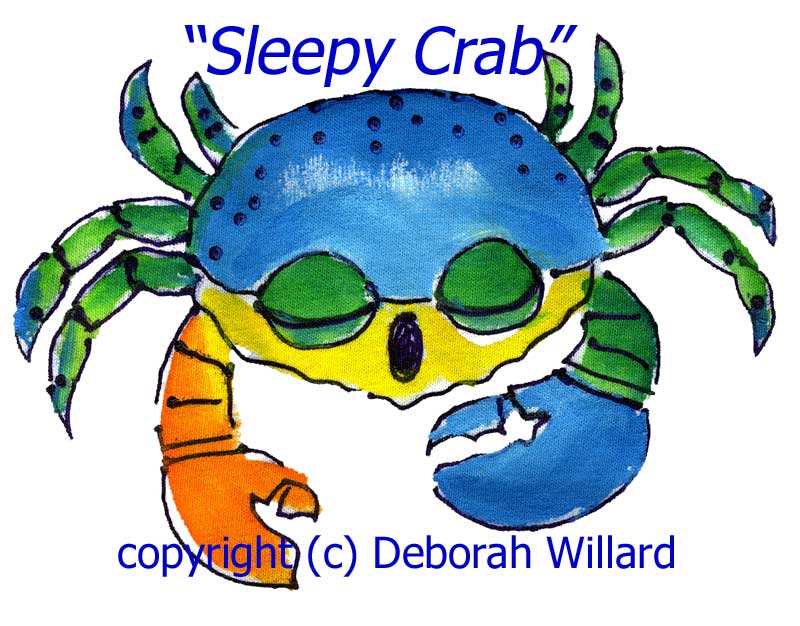
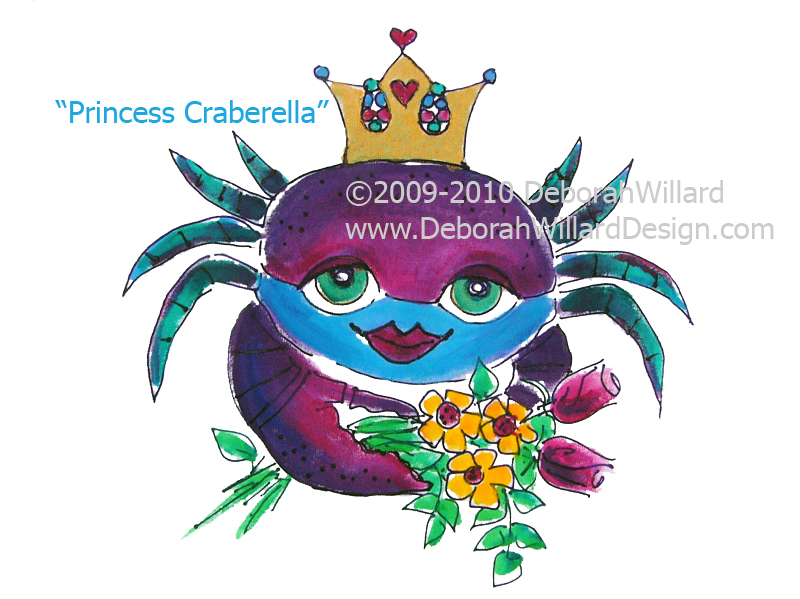 And Princess Crab, all girly-cute in pinks and purples. There are Cutest Crab and Sleepy Crab—one on the front of the shirt, the other on the back.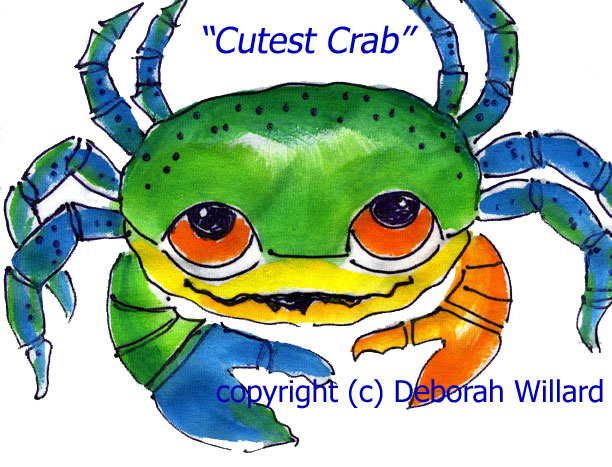
Pirate Crab is a great example of how a small mistake can become a memorable character. The eye patch, peg leg, hooks, and distorted “AAARRRRGGGHH” lettering give the design a story that feels perfect for short-form video. For anyone experimenting with playful ways to animate a photo of their artwork, a person, or even a pet, enzo fernandez celebration ai turns a single image into a 15-second vertical football-stadium celebration. It could be a fun way to give an original character a surprising match-day moment.
Pirate Crab sounds like such a fun example of a happy painting accident turning into a memorable character. I like how the peg leg, hook, and jolly roger kept the design evolving instead of being painted over. I’m also exploring AI UGC Video Generator for turning product ideas into short creator-style ads, and this kind of behind-the-scenes story is a great reminder that personality often comes from the unexpected details.
Pairing characters across the front and back of a shirt—like putting Cutest Crab upfront and Sleepy Crab on the reverse—adds a fun narrative layer to wearable pieces. Hand-painting each variation directly onto fabric keeps that character dynamic lively compared to rigid screen prints. Gauging where that line is between quirky and slightly too aggressive, like with the crushed fish design, is always an interesting trial-and-error process with customers.
Love the Pirate Crab origin story – the eye-patch accident turning a small mistake into a whole cast of characters (Starfish, Princess Crab, Happy Crab) is the kind of thing that only happens when you let a drawing wander. The detail about the claws distorting the letters in AAARRRRGGGHH is wonderful too, since the lettering becomes part of the crab itself rather than a separate label. If you ever want to sketch rough concepts or iterate on layouts faster, I’ve been having fun with Bernini AI
The accidental eye patch giving Pirate Crab his identity is a memorable origin story. I also liked the detail about his claws distorting the letters in AAARRRRGGGHH: the lettering becomes part of the character rather than a separate label. That kind of connection between character and text interests me as I work on creative videos at https://burningbridgesaivideo.pro/.
I love how Pirate Crab grew out of that happy accident with the eye — the kind of lucky mistake that turns a doodle into a whole cast of characters. Your Pirate Starfish and Princess Crab variations show how playful exploration can shape an entire little world. For anyone wanting to sketch or tweak crab-inspired illustrations of their own, I had fun experimenting with image editor ai.
I’ve tested dozens of online video tools, and vid2mp4.co is easily one of my go-to picks. It supports YouTube to MP4 along with TikTok, Instagram, X, Reddit and many other platforms.
What makes it different from most simple link downloaders: it’s not only for grabbing videos from URLs. You can also upload your local files to convert video formats and compress videos right in the browser. I often shrink large MOV or MKV files here to MP4 for sharing, it helps cut file size while keeping decent visual quality. Give it a try: [http://vid2mp4.co](http://vid2mp4.co)
What a lovely ‘happy accident’ story — Pirate Crab becoming an eye-patched character because of one misdrawn eye is exactly the kind of spontaneity that makes hand-drawn art feel alive. When I’m prepping reference clips for my own sketches I like to clean them up with video upscaler free so the details really pop.
For anyone collecting AI tools for creative projects, APIXO covers images, video, audio, and text, with developer access available alongside the browser workspace: https://apixo.ai/
Putting Sleepy Crab on the back of the shirt is the best joke in the post — the quiet one got the better spot, and I like to think that was on purpose. I record little voice notes about each piece while the paint dries, and the compressor hums under all of them; a run through clean up audio leaves just the voice. Crabby Crab, unbothered.
Really appreciate the insights here. Clear and practical, exactly what I needed.
The lettering variation adds something the pirate accessories alone cannot: the crab can physically bend the joke in “AAARRRRGGGHH.” It is also interesting that the more threatening fish-crushing version did not work for your audience. That contrast makes a useful distinction between adding recognizable character details and simply making a character fiercer.
The story of Pirate Crab growing from a happy accident into a whole family of characters is wonderful. I especially enjoyed how each variation keeps the original playful idea while giving it a new personality. When I research seasonal craft ideas and plan content around what readers are looking for, I use Trends Monitor to monitor Google Trends and rising related queries.
That happy accident with the eye turning into a pirate eye patch is such a charming origin story – it really shows how a small slip of the brush can spark an entire character. I love how each Pirate Crab variant keeps that playful spirit going. By the way, if you ever need to upscale old reference footage for study, I have been using video2x with great results – thought I would share!
What a lovely origin story for Pirate Crab — turning a misplaced eye into a signature eyepatch is such a fun happy accident. The character variations really show how one small idea can grow into a whole cast. If you ever want to bring these little pirates to life on screen, you can create music videos with your own artwork in minutes.
The eye-patch solution becoming Pirate Crab’s defining feature is a memorable example of an accident turning into a character idea. The later variations with the hook, flag, and lettering also show how a recognizable design can keep evolving. That balance between a stable character and new visual ideas is relevant to our prompt-preview project, BananaNano Art. The origin story gives those variations much more meaning than an image alone could.
Short‑form for blog snippet
If you want to turn a static character image into moving footage, give **Genjutsu (genjutsu.online)** a try. It is an AI motion‑transfer tool that maps poses, timing and camera movement from a reference video onto your input picture. You can generate dance clips, influencer content, product demo reels and fashion walk‑throughs without complex key‑frame editing. Credits are purchased as one‑time packs and never expire. Note: your source image and reference video should have matching framing for best results.
Link: [https://genjutsu.online/](https://genjutsu.online/)
The version where Pirate Crab grips the letters makes the lettering part of his personality, rather than just a caption. It is interesting that the Nemo-fish variation fell flat while the smaller quirks endured; the audience helps shape the character too. I maintain Dragon Bonding (dragonbonding.com), a free browser story with four original dragons, so this account of a character evolving through small decisions caught my attention.
Love how the Pirate Crab’s eye patch came from such a happy accident — that’s the kind of character moment that makes hand-drawn art feel alive. Your style reminds me of those little creative happy accidents I get when I edit short clips locally with MOV to MP3. Thanks for sharing!
The Pirate Crab origin story is the best part of this post – a messed-up eye turned into an eyepatch and a whole character was born. Seeing the design evolve over the years with the pegleg, the hooks and the “AAARRRRGGGHH” lettering shows how much personality a happy accident can carry. It is a nice reminder that creative projects reward patience. On a similar note, for anyone who likes low-key planning, lagoslife.si is an independent fan companion for the Lagos Life city-life game with guides and a free weekly budget planner, mentioned only as a casual reader aside.
Pirate Crab’s origin is a wonderful reminder that creative mistakes can become memorable signature details. The accidental eye patch, followed by the pegleg, hook, and playful “AAARRRRGGGHH” lettering, gives the character a genuine personality. Stories like this are also enjoyable material for language practice because the narrative is vivid and easy to follow. Mazelingo’s Japanese to English reading tool can turn favorite Japanese articles or personal stories into adjustable mixed-language readings, with unfamiliar English changing back to Japanese when clicked. A fun way to explore creative writing while building reading confidence.
Love how Pirate Crab started from a happy little accident with the eye-turned-eyepatch — those unexpected turns give characters so much charm. The range from Happy Crab to Princess Crab is delightful. It even inspired me to draft a quick text-art mascot using ASCII Art Generator for a fun side project.
Wow, that date brings back memories! It’s hard to believe how much time has passed since then.
Love the Pirate Crab origin story — the messed-up eye turning into an eye patch is exactly how the best characters get born. I keep coming back to hand-painted shirts like this for gifts. When I need a quick creative break between projects I mess around with Mimic Party (https://mimicparty.me/), a little free browser game where you imitate silly sounds with friends — no download needed. Anyway, Pirate Mountain Goat next please!
The eye-patch origin for Pirate Crab is a great example of turning a mistake into a beloved character.
I’ve been playing Control: Resonant recently and came across this guide site. Has anyone else tried it? Curious to hear what you guys think.
The eye-patch accident is a wonderful example of how a mistake can become a signature character. I especially enjoyed reading how Pirate Crab evolved alongside Pirate Starfish and the other crab designs. For documenting those variations on finished shirts, an ai photoshoot generator could offer a practical way to create consistent product images.
For people who need editable notes from documents, pdf to markdown is most useful when the workflow stays straightforward: select a text-based PDF or a clear English scan, review the resulting structure, and continue editing in a Markdown-friendly tool. Keeping the conversion in the browser also makes the privacy trade-off easier to understand, especially when a document should not be sent to an application server.
What a fascinating date to reflect on! It’s hard to believe how much time has passed since then.
rapduo lets you make amazing luxury hotel lobby AI videos. Create trending Hotel Lobby style rap videos with simple prompts, https://rapduoai.video
Recycling the St. John petroglyph into a jellyfish might be my favorite move in this whole crab universe — same carved shape, brand-new creature. I run a milder version of that trick on our AI math: feed the request volume into LLMomics and a monthly figure comes out with every rate still tied to its official source. The Nemo feud remains the boldest chapter in crustacean history.
The claws physically bending AAARRRRGGGHH out of line is the detail that won me over; hand lettering doesn’t get more honest than a word dragged off its line by the hand that made it. That’s the sort of lettering people try on Tinta Piel: a word should sit on your skin a while before it’s permanent.
Wow, that date brings back memories! It’s hard to believe how much time has passed since then.
Vocalove is an all-in-one AI creative toolkit packed with powerful image and video features.
It comes with AI Image Editor, AI Character Generator, AI Hairstyle Changer and the brand-new AI Hair Color Changer.
You can pick from multiple image models including Nano Banana, Nano Banana Pro, GPT Image 2.0, Flux Kontext Pro and Seedream 4.0 for image generation.
Beyond images, it also supports AI voice, speech cloning, image-to-video and trending AI video creation like Hotel Lobby style rap clips.
New users get free credits to test all functions without upfront payment.
Great for TikTok & Reels creators to make viral AI meme videos and character visuals quickly
https://vocalove.io/ai-image
Pirate Crab’s claws holding a couple of the letters of his own AAARRRRGGGHH so they come out properly crooked — calligraphic roots showing through a crustacean. The roster keeps quietly growing too: a pegleg here, a third hook there, a starfish waiting for its turn on the front. The unglamorous half of selling painted shirts is photographing them — glare, tags, half the workbench sneaking into frame — so shots get a PixPurge scrub before they go near the shop; re-staging a batch over one glare streak is a wasted evening. Did Pirate Mountain Goat get a pegleg too?
If you love creative projects like Deborah’s Pirate Crab—where a simple twist or “happy accident” turns into something unique—you’ll probably enjoy experimenting with AI for your own content! I recently tried out ai rap duo, a tool that lets you upload two portraits and instantly generate a custom rap video with AI vocals and beats. It’s super fun for friends or couples, and the results are just as playful and unexpected as a hand-painted shirt. Perfect if you want to try something new and share it on TikTok or Reels!
If you enjoy creative projects like Pirate Crab’s accidental origin story, you might love making your own viral videos! I recently discovered Hotel Lobby AI, an awesome tool where you can upload two photos and let AI generate a fun rap duo video with custom beats and vocals. It’s perfect for sharing on TikTok or Reels, and the results are as unique and playful as any hand-painted design. Check it out for a fresh way to showcase your creativity!
What a wonderful origin story — Pirate Crab’s eye patch being born from a happy accident really captures the magic of hand-painted work. I love how a single mistake can become the signature of an entire character. I’ve been exploring a similar playful spirit with Voe Ai
That’s such a fun happy accident! I love how a messed up paint mistake turned into your iconic Pirate Crab.
Minecraftdungeons2guide gear guide
Keeping on painting through the end of the world is the right response to December 21, 2012, and turning a messed-up eye into Pirate Crab’s eye patch is the best origin story I’ve read in a while. Our drawing table runs on the same logic: each kid pulls six random creatures on Random Pokemon Generator, and the creature that starts as a splotch usually ends up the team mascot. Does Pirate Crab still board new shirts, or has one of the shipmates quietly taken over?
Such a clever casual browser game — Size It Up!
No downloads, no account required, just open the website and play. You compare real‑world object silhouettes and guess their true physical size only with your eyes.
There are hundreds of objects: dinosaurs, animals, wind turbines, landmarks and everyday items. Daily challenge gives 5 rounds for up to 1000 points.
It’s surprisingly educational. Many real‑world things are way bigger or smaller than I imagined. Perfect quick game for killing spare time.
Minor downside: no multiplayer mode. Still highly recommended for puzzle / trivia fans.
https://sizeituponline.com/
That Pirate Crab origin from a messed-up eye patch is such a fun happy accident—so cool how art comes from little oops moments.
related resource
Wow, that date brings back memories! It’s hard to believe how much time has passed since then.
The bit about the messed-up eye being solved with an eye patch is a great reminder that accidents can become a character’s whole identity. Does Pirate Mountain Goat have a similar origin story, or was that one planned from the start?
I love fun estimation puzzle games.
If you enjoy guessing magnitudes and testing your intuition, try **RNGdle**: [https://rngdlegame.site/](https://rngdlegame.site/)
It’s a quick daily Fermi estimation challenge.
Excellent breakdown on “Friday, December 21, 2012”. I especially liked the point about original hand painted clothing, hats
Bookmarking this one for reference.
Excellent breakdown on “Friday, December 21, 2012”. I especially liked the point about original hand painted clothing, hats, accessories, and other stuff… The examples made it click quickly for me.
Loved this article—concise and useful. I especially liked the point about original hand painted clothing
Bookmarking this one for reference. We also build in this space at https://black-souls.net/.
We also build in this space at https://m3u8-player.app/. Thanks for sharing.
Very helpful and easy to follow. We also build in this space at https://morsecodetranslator.run/.
.We also build in this space at https://rule34dle.co/. Thanks for sharing.
The examples made it click quickly for me. We also build in this space at https://markdown-to-word.com/.
Very helpful and easy to follow. We also build in this space at https://kingshot-optimizer.com/.
.We also build in this space at https://soundloadmate.org/.
We also build in this space at https://deepnostalgia-ai.com/. Thanks for sharing.
The examples made it click quickly for me. We also build in this space at https://imagenatexto.app/.
Very helpful and easy to follow.
The world not ending today is a fun hook, and I like that Pirate Starfish sometimes gets to share the spotlight with Pirate Crab instead of always being the sidekick. If you ever want a voice-based party game to mess around with online for free, this one seems worth a look.
thechoicervoicer
The bit about the eye patch being the only fix for a messed-up eye is a great example of how a mistake can become the defining feature of a character. I’m curious how the pegleg and hook variations came about after that first shirt — were they planned additions or more happy accidents? The word play with the letters gripped by the claws also sounds like it would be tricky to keep legible while distorting them, which makes me wonder how much of the design gets worked out on the shirt versus beforehand. I found some background on measuring typing speed while reading about iterative design, keyboard speed testing, and it made me think about how repeated small revisions shape a final piece.
The detail about the messed-up eye leading to the eye patch is a nice reminder that accidents can become the whole character. I’m curious how the Pirate Crab design evolved from that first shirt into the pegleg and hook variations — was there a particular version that felt like the turning point? Also interesting that the meaner crabs get reserved for guys while the girly-cute ones go elsewhere; does that split come from customer requests or from your own read of the audience? The AAARRRRGGGHH letterplay sounds like the most fun to paint, since the claws distorting the letters would need some careful planning. For anyone who sketches lettering by hand, something like a typing speed test could be a way to warm up the fingers before committing to a design.
The reflection tied to December 21, 2012 captures how dates can carry cultural expectations that look very different in hindsight. Adding a short note about the artwork or image accompanying the post would provide useful context. For transparency, I maintain http://aimetadataremover.pro, an image metadata checking and cleaning website, and I appreciate personal archives that keep captions, dates, and images connected.
The connection between Agile, #ILookLikeAnEngineer, and the assumptions behind perception remains relevant. Concrete examples of how teams can challenge those assumptions during hiring and collaboration would make the reflection even more actionable. For transparency, I maintain http://aimetadataremover.pro, an image metadata checking and cleaning website, and I value discussions that encourage people to examine context before drawing conclusions.
It’s fun to see how a simple paint mistake evolved into such a distinct character like Pirate Crab. While I spend my days building tools to transcribe video content on Instagram Transcript, I find a lot of inspiration in how she uses happy accidents to drive her creative process.
The eye patch origin story for Pirate Crab is great—one messed-up eye turned into a whole character with a pegleg and hooks. I can see why the Nemo-crushing version didn’t go over well with the Disney crowd. I actually ran a channel through ytbench’s Monetization Checker the other day, so I get the appeal of free tools that just work. ytbench
Great story about the meanest crabs reserved for guys. It acknowledges that even whimsical designs carry social cues, and your awareness of that is thoughtful.
Pirate Crab going from a botched eye to a signature eye patch is exactly the kind of thing that makes a character feel like it actually survived a few bad sketches, not like it rolled off a design brief. The fact that Pirate Starfish occasionally steals the front of the shirt is fun too — it quietly turns a mascot into a little cast. Also, the “meanest crabs reserved for guys” observation is doing a lot of sociological heavy lifting for a crustacean in a hat. Do you think the flop variations teach you something before the audience does, or are you usually the last to know? Want to make a party game out of impressions like this? Check out ChoicerVoicerGame.
Pirate Crab going from a botched eye to a signature eye patch is the kind of happy accident that makes a character feel lived-in rather than designed. I keep wondering about the meanest crabs being reserved for guys and the Nemo-crushing version flopping with kids — that says more about the audience than the art. It reminds me of how AnimePhotoGen turns a plain selfie into something with way more personality than you’d expect. So when a variation bombs, is it the audience telling you, or do you already feel it while painting?
The detail about the messed-up eye leading to the eye patch is a nice reminder that accidents can become the whole character. You mention Pirate Crab first getting a pegleg and then a hook, and later sometimes three hooks or holding a jolly roger. When you’re deciding which accessories or props to add in a new version, do you start from a specific visual idea, or does the crab’s pose suggest what he should be holding?
The detail about the botched eye being fixed with an eye patch is a great example of a mistake turning into a signature character, and the note about the meanest crabs being saved for guys raises a question about how audience reaction shapes the variations over time. I also like that Pirate Starfish sometimes takes the front of the shirt, which makes the pair feel less like a mascot and more like a small cast. For anyone drafting artist statements or product descriptions around characters like these, this free AI text generator might be useful for generating text without losing that kind of specific voice.
Great read. If anyone needs a private Minecraft image converter, BlockArtLab (https://blockartlab.com) has been handy for wall art and map-art blueprints with real block counts.
Great read. If anyone needs a quick guide to bTV Action listings and live sports times, bTV Action Online (https://btvaction.online) has been a handy bookmark.
Good write-up. The section on Friday, December 21, 2012 lines up with what I ran into testing multi-account setups — the failure mode is almost always the number, not the automation. For anyone doing this at volume: I ended up using buy sms verification for the throwaway numbers, mostly because credits don’t expire and the API means I can pull an OTP without a browser in the loop. One thing I’d add is to test across a few country pools before committing to a provider. Coverage on paper and coverage at 2am are different numbers.
Great read. If anyone needs structured text from PDFs and Office docs, AnydocAI (https://anydocai.com) has been solid for local Markdown conversion across 21+ formats.
Wow, that date brings back memories! It’s hard to believe how much time has passed since then.
Highsfield helps marketers and small creative teams turn a campaign brief into a structured short-video concept. It organizes the audience, offer, proof, visual direction, and desired action into scenes that can be reviewed before production begins.
highsfield.com
The detail about the eye patch being a fix for a messed-up eye is what makes the Pirate Crab origin story land, since most character designs get reverse-engineered after the fact rather than rescued from a mistake. The note about reserving the meanest-looking crabs for guys, and the Nemo-crushing version flopping with kids, raises a question about how you decide when a variation has gone too far — is it audience reaction, or do you just know while painting? I sometimes wonder how much of that judgment could be captured in writing, which is part of why I keep looking at AI writing tools for drafting text around images. The AAARRRRGGGHH letterplay sounds like the strongest version, since the calligraphy background does something a plain pirate prop wouldn’t.
Integrating hand-drawn lettering directly into the artwork—like having the crab’s claws actively pinch and distort the text of “AAARRRRGGGHH”—is such a fun design touch. Happy accidents like covering a slip-up with an eyepatch often yield the most memorable character concepts. Do you usually map out that distorted typography beforehand, or just freehand the letters straight onto the fabric around the claws?
Helpful article. I’ve been testing a few transcription tools lately; VideoTranscriptGen (https://videotranscriptgen.com) stands out for clickable timestamps and exporting both TXT and subtitle files in one pass.
Helpful piece — thanks for writing this up. On a related note for founders naming a product, I’ve been using NamingCube (https://namingcube.com) to brainstorm ideas and instantly check .com availability via live RDAP before locking anything in.
Really helpful article — thanks for sharing. I have been testing privacy-friendly image tools lately; Purgebg (https://purgebg.com) is a free AI background remover that works well for quick product photos.
The story behind Pirate Crab’s eyepatch coming from a happy accident is honestly one of my favorite creative origins. There’s something really charming about how one small mistake turned into an entire character that people love. It’s a refreshing read — especially now when my days are usually spent tinkering with visual effects and animation tools over at AI Kissing Generator.
The way Pirate Crab evolved from a simple paint mishap into such a charming character — especially the “AAARRRRGGGHH” wordplay with his claws distorting the letters — is genuinely delightful. It’s the kind of careful, thoughtful craft I really admire while experimenting with transparent image reveals over at Tap and hold.
I love how this post captures the creative momentum that builds toward the end of the year — it’s the kind of thoughtful read that’s a welcome mental break from spending most of my time analyzing facial proportions and structural I also explore visual aesthetics over at PSL Rating.
The messed-up eye that became Pirate Crab’s eyepatch is the best kind of happy accident. I’d feed a clip of that AAARRRRGGGHH lettering through Summarize Video to keep the transcript.
Love Deborah’s playful, story-driven approach to art—especially how “happy accidents” like Pirate Crab’s eye patch birth iconic characters! If you’re prepping hand-painted designs for print or web (like those vibrant crab shirts), try ImgLoop.ai for quick, private AI photo edits—no sign-up needed. Restore old artwork scans, tweak backgrounds, relight details, or generate fresh style variations—all in-browser with local tools and zero auto-sharing. Free tier includes 2 lifetime credits; plans start at $14.99/mo. Perfect for artists refining assets before Etsy or Zazzle uploads:
Try ImgLoop now
The explanation in “Friday, December 21, 2012 – DeborahWillardDesign” is clear and includes useful practical details. When preparing supporting images before publishing them, a tool such as webp png 変換 can also be helpful.
I stopped on this detail: “Friday, December 21, 2012 Posted on December 21, 2012 by Deborah — 78 Comments ↓ The world did not end today.” That is the line that made the rest of the page usable.
Turning the misplaced eye into an eye patch gives Pirate Crab a memorable origin story. The version with the claws gripping and bending the letters also makes the lettering part of the character, instead of just a caption beneath it. Comment from tirepressurecheck.
I stopped on this detail: “Friday, December 21, 2012 Posted on December 21, 2012 by Deborah — 76 Comments ↓ The world did not end today.” That is the line that made the rest of the page usable.
New to Bazi? This intro explains the Four Pillars of Destiny without the jargon: Bazi meaning explained
Higgfield is a motion-planning prototype for creators who want to explore how a still photo could be animated. It helps users choose an effect, define protected image details, adjust motion direction, and prepare a reviewable plan before using a production tool.
higgfield.cc
The “AAARRRRGGGHH” detail is my favourite part of this post. Having the crab physically grip and squash a couple of the letters is the kind of wordplay that only works when the lettering is painted by hand, because the distortion has to follow the claws — no font could do that. It also shows how a calligraphy background carries through even on a pirate crab shirt: the uneven baseline reads as deliberate rather than sloppy because the letterforms themselves stay consistent. Glad the world didn’t end and Pirate Crab got to keep going.
The copy-paste behaviour across apps is the part nobody documents, which is most of why I keep a superscript generator handy on my side. Genuinely useful breakdown of Friday, December 21, 2012. Worth testing on a couple of devices before rolling it out everywhere.
WigSay is built around a simple idea: choosing a hairstyle should begin with seeing, not guessing. The product gives people a private space to compare cuts, lengths, textures, and bangs on their own portrait before visiting a salon or changing their look. “Wig” makes the category immediately familiar, while “Say” reflects the confidence to express a choice clearly. WigSay does not promise a perfect prediction; it turns a vague style idea into a useful visual conversation.
wigsay.com
I like that you focus on the fact that painted him twice and sold the one off the wall in the past 10 days or so. My setup is a Mac Studio with a rotating cast of test systems on it. So when I want to check how something behaves on ARM, I use virtual machine for Mac to spin up macOS and Linux ARM images without emulating x86. Would be interested to hear how you would approach it now. Do you usually test this kind of thing on real hardware or in a throwaway setup?
Really useful write-up. I have been using Img2Vid (img2vid.net) for similar work lately.
Helpful post — related tool I use: GPT Images.
Hearing the voice of a loved one again can be incredibly comforting.
**Vocalove** is a privacy‑focused zero‑shot voice‑cloning tool hosted on fal marketplace. It only requires a short 3–30 second audio sample, with no lengthy training required.
It supports a wide range of voice‑generation use‑cases: memorial storytelling for family, partners and pets, custom audiobook narration, personal podcast voice‑overs, creative character voice acting, video voice‑over production and custom‑tailored audio content for personal projects. It uses one‑time credit packs without recurring subscription fees.
Important ethics reminder: please only clone voices you own or hold explicit permission to use.
[https://vocalove.io](https://vocalove.io)
I love how Pirate Crab was born out of a happy accident! Turning a painted mistake into a signature eyepatch is classic creative problem-solving, and the idea of him clutching the letters in “AAARRRRGGGHH” is fantastic. A character with that much personality practically deserves his own pirate theme track. You could take some of these fun character backstories and feed them into a tool like GetRapAI to generate a Pirate Crab rap song to play in your shop while you paint.
The bit about the messed-up eye leading to the eye patch is the part that stuck with me, since a lot of recurring characters seem to start as a fix for something that went wrong rather than a plan. The list of variations is interesting too, especially the hooks and pegleg arriving one at a time over the years instead of all at once. I’ve noticed that kind of gradual drift in character design work that evolves over time where small design decisions accumulate into something recognizable.
KuanKeDao means a broad path. The directory is designed for people who know the outcome they need but do not want to search through endless launch feeds. It organizes AI productivity tools around actual work: writing, meetings, research, automation, data, and team operations. Each listing should explain who the tool is for, where it fits, what it costs, and what to compare next. KuanKeDao is not a popularity contest; it is a clearer road from a work problem to a useful shortlist.
kuankedao.com
CanvasSeed turns one campaign idea into a coordinated set of social media creative directions. Its guided workflow carries the same concept across visual ideas, captions, hashtags, and short-video storyboards so the final campaign remains consistent.
canvasseed.com
The explanation of “Friday, December 21, 2012” is easy to scan while still giving enough context. I’m bookmarking the page because the practical notes are more useful than a high-level list.
The point about lighting and compression affecting landmark detection is worth emphasizing. A numerical score can still reflect the assumptions of the model, so it should not be treated as a universal standard of attractiveness. Before uploading a portrait, I would also check the service’s retention policy and review the file for location metadata. Removing metadata does not make a recognizable face anonymous.
The joke about a ball landing in someone’s drink gets at a practical issue: an activity needs to fit the space as well as the child. Quiet options with few loose pieces seem easier to manage. I run https://removeailabel.app, an image metadata tool; for the travel-blogging side, review family photo copies before posting and keep boarding passes out of the frame.
Turning the mistaken eye into Pirate Crab’s eye patch is a memorable example of letting a painting change direction. A dated sequence of the character’s variations would make a wonderful process archive. I run https://removeailabel.app, an image metadata tool, and suggest preserving original artwork photographs while using separate copies for publishing, with your authorship clearly credited on the page.
It is fascinating how a simple mistake with a paintbrush led to the creation of such an iconic character. The way you incorporate wordplay into your designs is clever, and it makes me wonder if a tool like GetRapAI could be used to create a fun, thematic soundtrack to accompany your gallery or showcase your creative process.
Calc.you provides focused calculators for everyday plans involving dates, routines, personal goals, and shared costs. Each calculation runs locally and presents its units, assumptions, and method without requiring an account.
calc.you
The crab holding and distorting the letters is a specific detail that connects your painting with your calligraphic roots. Showing a few lettering variations side by side could make an interesting follow-up. I maintain GridHanzi (https://gridhanzi.org/), a Chinese handwriting worksheet tool. For someone exploring Chinese lettering, practising the characters on paper before adapting them into artwork could help keep the written forms recognisable while experimenting with composition.
Thanks for sharing. Bookmarking this alongside Open HEVC Video.
Helpful post — related tool I use: PNG to Hex Converter.
Pirate Crab sounds like he owes everything to a locked door and good music. Those happy accidents usually turn out to be the best work. I love that you painted the Mountain Goat too. St. John must be an incredible place to source faces and shapes like these. Keep them coming!
“The world did not end today” made me laugh — definitely a good reason to keep painting Pirate Crab. The hand-painted designs have so much personality already; seeing one of them brought to life as a playful little animated clip with wan 3.0 could be really fun.
Really useful write-up. I have been using Remove AI Metadata From Photo (removeaimetadatafromphoto.org) for similar work lately.
Thanks for sharing. Bookmarking this alongside Deep Fried Image Generator.
Thanks for sharing. Bookmarking this alongside Buble.
Helpful post — related tool I use: ImageDPIChanger.
Given that the world didn’t end, I’m glad Pirate Starfish still gets its moment on the front of the shirt. I was actually busy making silly doomsday captions with this Unicode text converter that day, and then it just became an ordinary Friday.
Great article, thanks for sharing! https://typingwordsgif.com/
Solid points here. For deck visuals I often sketch with Freegen: https://freegenai.app/.
Helpful post — related tool I use: AI Bathroom Design.
Helpful post — related tool I use: Image Size Checker.
Helpful post — related tool I use: Minesweeper Solver from Image.
Helpful post — related tool I use: Restaurant Bill Generator.
The happy accident that created Pirate Crab is such a great origin story, especially how the eye patch led to the pegleg, hook, and other variations. Do you still have the original shirt design, or has the character changed so much that it feels like a completely different crab now?
The playful irony of posting about Pirate Crab and Pirate Starfish on the supposed apocalypse date is a great reminder that creative work thrives on continuity, not catastrophe. It’s striking that you sold a painting off the wall within ten days—does that immediate connection with a buyer change how you approach the next piece, or does each new subject stay as fresh as the first? You’re also welcome to use it. ai-clothes-changer
Interesting read — we use Image to Draw.io for similar creative workflows: Image to Draw.io.
Pirate Crab is a lovely example of an accident becoming a repeatable visual character. When artwork moves from a painted shirt to an online shop or print, I think keeping a high-resolution master matters more than making every copy look artificially sharp. I built FreeUpscaler (my own project) for carefully checking an older image copy in the browser: https://freeupscaler.net/enhance-photo-quality. I would keep the original scan or photo alongside any web-sized export.
I like the idea of Pirate Starfish sometimes moving from the back of the Pirate Crab shirt to the front; it makes the design feel like it has its own little cast. For anyone experimenting with quick visual concepts, TopView AI’s video agent page Topview AI Video Agent Explained – Free Agent-Style Generato could be a useful related resource.
Loved the backstory behind Pirate Crab—especially how a mistake turned into a signature character. It’s a great reminder that happy accidents can lead to the most memorable designs. purupurumaker.io
The happy accident behind Pirate Crab is such a great origin story, especially how one botched eye became an eye patch and then a whole character. After all those variations, do you still have a favorite version, or does the latest design usually become the most exciting one to paint?
Really enjoyed this write-up, the way you explained it made it easy to follow. If anyone is into car aesthetics, Tesla Wrap Colors has some great visual ideas. Thanks for sharing!
Really enjoyed this write-up, thanks for sharing! On a related note, I recently came across a handy Tesla wrap color visualizer at https://teslawrapcolors.com/ that lets you preview wrap colors – thought some readers here might find it useful too.
A dated journal-style post that still reads like a quiet end-of-week note. For simple QR links in design handoffs I also use https://morphq.com/.
For anyone inspired by Deborah’s journey of turning happy accidents into unique hand-painted art, there’s an exciting digital tool you might love! If you’re curious about bringing your artwork or illustrations to life with natural motion and atmosphere, check out this image to video ai platform. It lets you easily transform photos or drawings into engaging AI-powered videos—perfect for showcasing characters like Pirate Crab in a whole new way!
Absolutely love reading about the creative process behind Pirate Crab and how a simple painting mishap evolved into such a beloved character! For fellow artists or anyone interested in experimenting with their designs digitally before committing to canvas, I highly recommend trying out this platform where you can easily edit image files, generate AI art, and even create videos. It’s a fantastic way to play with different variations of your artwork and spark new ideas—plus, it’s free to start!
I created Tape Note, a simple digital gift tool for making personalized cassette-style mixtapes. Choose a cassette design, add songs and stickers, write a personal note, and share the finished gift with one link. It is made for birthdays, anniversaries, thank-you messages, or any moment worth remembering.
Loved reading about how Pirate Crab evolved through happy accidents — it’s such a refreshing creative story, especially compared to the fast-paced cognitive recall required when I’m curating historical trivia over at Name 100 Women.
The story behind Pirate Crab being born from a happy accident—turning a messed-up eye into an iconic character—was such a charming reminder that creativity thrives on embracing mistakes. It actually sparks some ideas for my own work at Country Draw, where visual experimentation and learning through trial-and-error are just as much a part of the process.
Love this origin story of Pirate Crab — it’s amazing how a small accident can spark a character with so much personality. As someone who enjoys playful, visual storytelling, I often use quick AI tools to explore variations and new ideas before picking up a brush. It’s a fun way to test concepts like “what if Pirate Crab had a different pose?” without losing that handmade charm. If you ever want to brainstorm character designs or just mess around with free image ideas, you can try GPT Image 3 — it’s surprisingly handy for visual inspiration. Great post, and keep painting those crabs!
Love the origin story behind the pirate crab illustration! It reminds me of how a fun backstory can make a character come to life. This has a playful, voice-like personality to it — it actually makes me think of The Choicer Voicer, a browser game where you listen to a line, imitate the delivery, and face five computer judges. Great work on this piece!
What a delightful story behind Pirate Crab—love how accidents can spark such iconic creations. It’s amazing how much personality and evolution a single character can carry over time, just like your art itself. If you ever want to bring those whimsical characters to life with motion and sound, lets you turn a photo or idea into a 4-to-15-second video with full audio and music in one go—no account needed, no email, just creativity. MiniMax H3 AI Video Generator
The detail that the world did not end creates a wonderfully grounded setup for returning to the studio. It also gives the Pirate Crab a little narrative weight: an ordinary act of making and showing art continues despite the day’s dramatic joke. Selling one from the wall so quickly is a reminder that display placement can make a piece part of the conversation before anyone decides to take it home.
The bit about Pirate Crab bending the letters in “AAARRRRGGGHH” made me smile. It turns the lettering into part of the character instead of leaving it as a caption; the calligraphy and illustration feel like the same joke.
Comparing this to the more conventional step-by-step design process, I find the idea of starting from the emotional response rather than the brief really shifts the priorities. It feels less like a checklist and more like a conversation. Do you find clients respond better to that approach, or does it take longer to get their buy-in?
practical web tool
The contrast between the world continuing as normal and a small creative success gives this post a memorable sense of scale. Keeping on with paintings such as Pirate Crab feels like a grounded response to a dramatic date, while the sale of one piece shows how quickly handmade work can find its audience. Documenting a second version also preserves the idea after the original leaves the studio, which is valuable for both reflection and future work.
The story behind Pirate Crab being born from a happy accident really resonates with me—the way that messed-up eye became his signature detail is such a beautiful reminder that imperfection can spark the most memorable designs. It actually gives me some fresh inspiration for my own visual projects at AI Video Generator Free, where I explore how AI-generated video tools can capture similar organic creativity in motion. Love how both hand-painted art and AI visuals can evolve unexpectedly into something even better than the original plan.
I also explore related creative ideas over at Omegaverse Quiz.
Design posts like this show how visual choices often need a second layer of explanation before someone else can understand the intent. I see the same issue with brick-style model images: the final view is appealing, but the build sequence is what makes it teachable. I work on BrickGPT, which creates staged build boards and short assembly videos from one finished model image.
I built mojing.org, a real-time cloud drive search engine that aggregates links across Aliyun Drive, Quark, Baidu Pan, 115 and Xunlei, with duplicate filtering and trending lists. Feel free to check it out: https://mojing.org/
I like the story behind Pirate Crab, especially how an imperfect eye turned into the character’s defining detail. The way the design kept evolving with the peg leg and hook is a good reminder that accidental marks can become a stronger visual identity than the original plan.
Glad the world didn’t end back then so Pirate Starfish could finally take center stage on your shirts! Giving the companion character the spotlight is such a fun design choice. It reminds me of how creative artists share their process online today whenever I browse art clips or view tiktok stories for craft ideas. Keep up the wonderful hand-painted work!
Really useful for newcomers! I’d also point new players to ai ghost mannequin for ai ghost mannequin basics.
The way Pirate Crab kept evolving with each new mistake—adding the pegleg, the hook, the jolly roger—felt like watching a living character grow, which is honestly such a cool parallel I also explore related creative ideas over at Sprinki Sbrunga.
I love the story behind Pirate Crab and how one happy accident turned into such a beloved character — there’s something really special about letting mistakes become part of the design. It reminds me that some of the best creative moments come from unexpected brushstrokes, whether you’re painting a shirt or running gender predictions over at Baby Gender Predictor. Would love to see what a Pirate Crab onesie looks like!
Wow, that date brings back memories! It’s hard to believe how much time has passed since then.
Wow, that date brings back memories! It’s hard to believe how much time has passed since then.
The eye-patch fix made me laugh because the two of us handle mistakes in opposite ways: I repaint everything, while my friend turns the slip into a new character. KnowUsWell gave us a similar conversation about our habits—did Pirate Mountain Goat also begin with an unexpected brushstroke?
That date certainly brings back memories of the Mayan calendar predictions! It’s interesting to reflect on how much attention that got.
This date brings back so many memories! It’s amazing how quickly time flies.
At this moment I am going to do my breakfast, later than having my breakfast coming over again to read
additional news.
Thanks in favor of sharing such a nice thought, post is good, thats why i have read it entirely
I read this piece of writing completely about the comparison of newest and previous technologies, it’s remarkable article.
Pingback: Dubai Ubar
Hello, its nice paragraph about media print, we all understand media is a wonderful source of information.